


Bee bread: a natural superfood for your immune system and wellbeing
Bee bread, known to the ancient Greeks as the “Food of the Gods”, is one of nature’s most nutritious superfoods. It is formed by fermenting pollen, a process that increases its nutritional value and improves its absorption by the body.
Bee bread is rich in essential vitamins, minerals, amino acids and enzymes that support energy, strengthen the immune system and improve overall wellbeing.
Our bee bread is collected in the Šilutė district, where bees feed on the nectar of various flowers, ensuring a natural product with high nutritional value.
Health benefits of bee bread
Rich in nutrients – bee bread contains protein, vitamins, minerals, antioxidants, flavonoids and polyphenols.
Increases energy and stamina – thanks to its high content of natural protein, amino acids and B vitamins, bee bread is an excellent natural source of energy, particularly suitable for athletes and people with active lifestyles.
Supports digestion and the gut microbiome – bee bread has probiotic properties that improve digestion and the absorption of nutrients.
Fermented product – bee bread naturally ferments in the cells of the honeycomb, so its flavour and texture differ from those of pollen.
Improves brain function and reduces stress – bee bread has neuroprotective properties that help improve concentration, memory and cognitive function, while reducing fatigue and stress.
How to take bee bread
✔ Daily – 1 teaspoon per day.
✔ During the cold season – 1-2 teaspoons per day.
✔ In smoothies and drinks – You can add it to smoothies, teas or warm water with honey.
✔ As a nutritious snack – Eat it on its own or mix it with yoghurt, porridge or honey.
✔ For athletes and active people – Suitable before or after exercise as a natural source of energy.
Bee bread in your everyday diet
Bee bread contains iron, copper, folic acid and B vitamins. It is a nourishing hive product that many people choose as part of a varied diet. If you have been diagnosed with anaemia or iron deficiency, talk to your doctor about your diet.
Because of fermentation, the nutrients in bee bread are absorbed much better than from pollen alone. That makes it an excellent natural choice:
✔ For active people and athletes – as a natural snack before or after exercise.
✔ For breakfast – with yoghurt, porridge or honey.
✔ During pregnancy and breastfeeding – only after consulting a doctor.
Recommended course: 1 teaspoon (about 5 g) a day in the morning on an empty stomach. The course can continue all year round, as it is a natural product.
Bee bread for children and the whole family
Bee bread suits the whole family: it is one of the safest bee products even for young children, because fermentation reduces the allergenic properties of pollen.
Recommended amount by age:
✔ Children aged 1 to 3 – ¼ teaspoon per day.
✔ Children aged 3 to 6 – ½ teaspoon per day.
✔ Children aged 6 to 12 – 1 teaspoon per day.
✔ Teenagers and adults – 1-2 teaspoons (5-10 g) per day.
It is best to give children bee bread with honey, yoghurt or porridge, so it is easier to eat and tastes nicer. The first time, give a very small amount and watch for any allergic reaction. Bee products are not recommended for children under 1 year.
Give children bee bread in small amounts, starting with ¼ teaspoon, and watch for any allergic reaction.
Who should not take bee bread
Although bee bread is a natural product, in some cases it should be taken with care or after talking to a doctor:
- People allergic to bee products or pollen: always start with a very small amount the first time.
- Children under 1 year: bee products are not recommended for babies.
- People with serious autoimmune diseases: always talk to your doctor first.
- People taking blood thinners: bee bread may add to their effect, so take care.
Always stick to the recommended amounts: taking more brings no extra benefit.
How is bee bread made?
Bee bread is made from pollen collected by worker bees. Before flying out to gather pollen, a bee takes a little honey from the hive, but that is certainly not its lunch. Flying from flower to flower, bees collect pollen, moisten it slightly with a mixture of saliva and honey, and then pack it into special “baskets” on their hind legs, known as corbiculae. When they return to the hive, the bees leave this pollen near the combs where bee larvae grow.
Later, young worker bees add a little honey and their own saliva, which makes the bee bread rich in protein. The mixture is then pressed into the hexagonal comb cells and begins to ferment without oxygen. This process, called lactic acid fermentation, protects bee bread from mould and decay. Fermentation takes about 7 days, after which the bee bread is ready to eat!
Buy bee bread online
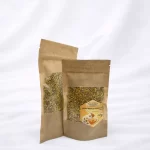
Order natural bee bread delivered to your home! Packed with antioxidants, vitamins and minerals, it is a true hive superfood for your everyday diet.
Scientific article about bee bread: https://pmc.ncbi.nlm.nih.gov/articles/PMC6943659/
Frequently asked questions about bee bread
Bee bread is best taken in the morning on an empty stomach, letting it dissolve in the mouth. Adults: 1-2 teaspoons (5-10 g) a day. You can add it to tea (no hotter than 40 °C), a smoothie, yoghurt or porridge.
Bee bread is fermented pollen with honey and bee enzymes. Thanks to fermentation its nutrients are absorbed better, and it has probiotic properties that plain pollen does not have.
Bee bread can be given to children from 1 year of age, starting with a very small amount: ¼ teaspoon a day. Bee products are not recommended before the age of 1.
Yes, bee bread is suitable for daily use. A preventive course usually lasts 4-6 weeks and is repeated 2-3 times a year, especially in autumn and spring.
Keep it in a tightly closed container in a dry, cool place away from direct sunlight. Stored properly, bee bread keeps its properties for up to 12 months.
Bee bread is not a cure for colds. It contains antioxidants, vitamin C and flavonoids, so it can be part of a varied diet. If you are ill, see a doctor.
Bee bread is rich in folic acid, iron and other substances important during pregnancy, but it is best to talk to your doctor before you start taking it.
Food product. Bee products are not medicines and do not replace a varied, balanced diet or treatment prescribed by a doctor. If you are ill, pregnant or taking medication, talk to your doctor before use.


